
Power County Deed Types
Not every deed promises the same thing. The deed type fixes the interest conveyed and the promises the grantor makes, so read the full instrument, including its legal description, signatures, acknowledgments, and recording stamp. One deed is often a single link in a chain. Corrective documents, releases, plats, or court orders may sit alongside it.
| Deed Type | What It Does | Common Use |
|---|---|---|
| Warranty deed | Conveys title with stated covenants | Ordinary purchase transfer |
| Quitclaim deed | Conveys whatever interest the grantor holds | Family, entity, or title cleanup |
| Trustee deed | Conveys through a trustee's authority | Trust or secured-property transfer |
| Personal representative deed | Conveys through estate authority | Probate-related transfer |
| Tax deed | Records a completed statutory tax-deed event | Delinquent-tax process |
A deed transfers ownership. A mortgage, trust deed, judgment lien, or lis pendens does not. Those instruments burden the interest, and every release or reconveyance must be matched to the original instrument it retires.
Request Power County Deeds Offline
Power County offers no public grantor-grantee web index. No document image search exists online either. The dependable channel is the Clerk/Recorder, located at 543 Bannock Avenue, American Falls, Idaho 83211, reachable at 208-226-7611. An in-person inquiry, written request, or county records form can reach the indexed, microfilmed, and scanned holdings.
The office page describes the record categories and their preservation, but results still require a direct search or request. Details matter. Give the parcel number and the current owner. Include the verbatim legal description if known, any trust or business name variants, the approximate transfer date, and the CUR_DEED reference from the parcel map.
Power County Recorder Search Keys
Deeds are indexed by names, not street addresses. A specific request keyed to parties and legal descriptions routes the main deed-record tasks better than an address alone.
| Recorder task | Keys to provide | Expected route |
|---|---|---|
| Current deed | Parcel, legal description, owner, CUR_DEED | Office search and copy |
| Ownership chain | Grantor, grantee, entity variants, date range | Grantor-grantee index |
| Liens | Party, parcel, lien type and dates | Index plus instrument review |
| Plat or survey | Subdivision, lot/block or township/section/range | Recorded map file |
The county request form also asks for delivery preference and whether the requester wants to examine or copy records. Payment may be required first.
Power County Grantor-Grantee Chain
Start with the latest deed. Guessing at a former owner wastes time. The grantee receives the interest, the grantor gives it up, and each confirmed recording reference supplies the next step backward.
- Use the parcel map's owner and current deed reference to request the newest instrument.
- Record the grantee, grantor, date, instrument number, and exact land description.
- Search the grantor as a former grantee and obtain that acquisition deed.
- Repeat while reconciling splits, combinations, replats, trusts, estates, and name changes.
- Grantor
- The party that transfers the stated interest.
- Grantee
- The party that receives the stated interest.
- Chain of title
- The linked sequence of instruments affecting the same land.
- Instrument reference
- The Recorder's identifying number or book-and-page citation.
Older Power County Deed Books
The Recorder publishes no online index. So the county itself states no earliest online coverage year. One secondary finding aid reports Power County deed records covering 1897 through 1951. The catalog item and its image restrictions may vary. Treat that span as a lead, not promised coverage. Ask the Recorder about the index cutoff, deed-book series, and microfilm access. Ask too about any pre-1913 custody question. Power County was organized in 1913. Older homestead, mining, and land activity may have begun in predecessor or federal systems. The Idaho State Archives and the FamilySearch Catalog can help locate those series. They help most once the Recorder route is clear.
American Falls Deed Geography
In 1925, dam relocation moved most of American Falls to a planned site on higher ground. Historic deeds may still name the old townsite. They can reference moved buildings, earlier lot-and-block descriptions, or flooded land. A modern address often matches none of it. Recorded plats and verbatim deed text bridge the eras. Newspapers and Historical Society accounts explain the move, but only the recorded instrument establishes the ownership chain, even for properties like the submerged Oneida milling and elevator foundation that lack a modern taxable parcel.
Power County Estate Transfers
Probate transfers appear in several forms. A personal representative deed can move title through an estate. So can a beneficiary deed, affidavit, court order, or distribution instrument. Search Idaho iCourt for the estate. Then request the public, unsealed case document from the Power County court clerk and match it to the Recorder's instrument and legal description. An assessment-roll name alone cannot prove the transfer is complete. Vital certificates follow separate Idaho eligibility and confidentiality rules. They never replace the recorded title instrument.
Order a Power County Deed
The Recorder fee page lists recorded copies at $1 per page and computer printouts at $1 for the first page plus $0.15 for each added page. Certification adds $1. The schedule lists a lien search at $5 per name. Confirm current fees before sending payment.
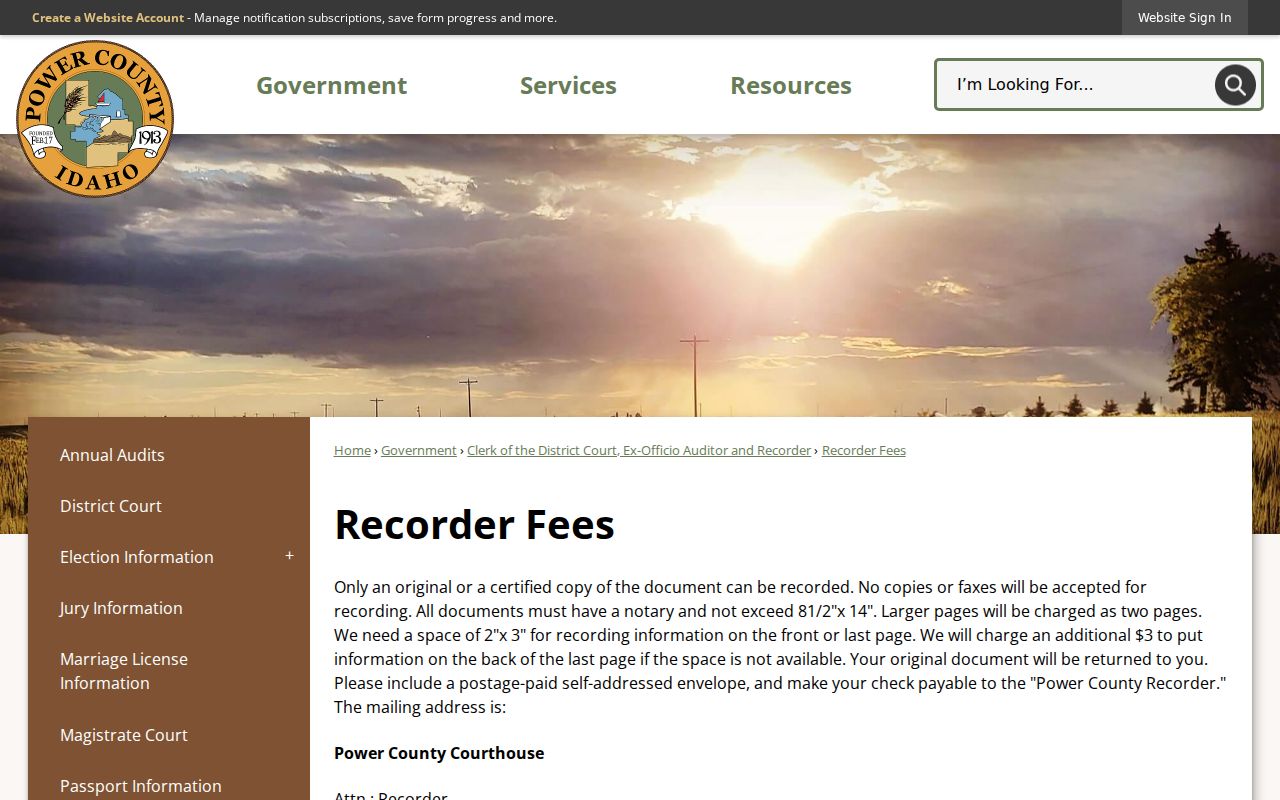
The published schedule separates copies, certification, searches, and recording. Mail requests go to Power County Recorder, 543 Bannock Avenue, American Falls, ID 83211, with checks payable to Power County Recorder. Recording asks more than copying. It requires an original or certified copy, notarization, approved page size and recording space, and a postage-paid self-addressed envelope.
Recorded, not guaranteed. Power County deed records show instruments accepted for recording. They do not provide a title opinion, resolve every defect, or rule out unrecorded interests.
Power County Deed Request Channels
Power County deed records reach beyond the browser. The county publishes no online grantor-grantee index or deed-image viewer. So a Power County property search for deeds begins with the Clerk/Recorder at 543 Bannock Avenue in American Falls. Call 208-226-7611, stop at the counter, mail a copy order, or file the county's written public-records form. The Recorder keeps documents indexed, scanned, and microfilmed.
Help the office pinpoint the instrument. List every grantor and grantee spelling, trust or entity variants, an approximate recording range, the parcel number, the full legal description, and the CUR_DEED value from the parcel map. Liens and releases need the instrument type and party named. For plats or surveys, cite the subdivision and lot and block, or the township, section, and range.
State the product you want, too. Inspection alone can settle an index question. A plain copy suits working research. A certified copy carries the Recorder's certification. The published fee schedule covers copies, computer printouts, certification, lien searches, and recording. Ask about the current total, payment methods, page count, and return mail before you send money.
One caution about mail. Recording requirements do not govern a simple copy order. Recording an instrument demands an original or certified document, notarization, approved page size and recording space, and a postage-paid self-addressed envelope. Say plainly that you want an existing deed, so the office does not mistake your copy order for a recording task.
Test the Power County Deed Chain
A chain of title is a linked sequence, not a name list. Begin with the newest confirmed deed. Record its instrument number or book and page. Also record the recording date, deed type, grantor, grantee, and full legal description. Then hunt that grantor as an earlier grantee. Repeat only when the legal description and recording details truly connect one transfer to the next.
Track the rest of the parcel file apart from conveyances. Mortgages, deeds of trust, assignments, reconveyances, releases, easements, restrictions, liens, and lis pendens can burden or explain a parcel. They do all this without changing the assessment owner. Match every release to the obligation it clears. A court filing or tax-deed notice is not yet a final recorded transfer.
Give splits, combinations, exceptions, corrective deeds, and replats their own check. The assessor's short legal description may omit an exception that controls the question. Compare LGDESC1 and LGDESC2 against the verbatim deed and the newest recorded plat or survey. Keep both old and new parcel numbers if the tax parcel changed.
History adds a geographic trap here. The 1925 relocation of American Falls moved people, businesses, and buildings to a new townsite. Some former land went under water. An old address or newspaper notice may point to the original grid. It may also point to a structure that moved while the land stayed put. The Historical Society and newspapers can explain the clue. The Recorder's deed and plat still control the chain in Power County property records.
Verify Power County Transfer Context
Estate and court files can explain an odd deed. Search Idaho iCourt by estate, trustee, personal representative, entity, or party name, then request the public court document when the online result falls short. Match any order or probate transfer to the recorded instrument and its legal description.
Secretary of State business records can clarify an LLC name or registered agent, though they never prove ownership. Vital certificates carry their own confidentiality and eligibility rules. Neither source replaces the deed. When a gap remains, treat it as an access limit and ask the Recorder for the index series and years instead of concluding that no transfer ever occurred in Power County deed records.